

POOF!
At the 2026 North American School Scrabble Championship, Pink Fluffy Unicorns, a 790-point game, and more confusion over what is and isn't a valid word


Note: This story includes discussion of offensive words.
The 2026 North American School Scrabble Championship in downtown DC last weekend was a banger. More than 80 kids competed, from nine states, one should-be state, one Canadian province, and the United Arab Emirates—a student whose family had to evacuate a couple of weeks earlier. They played 210 games (give or take) in a top-floor ballroom at the gorgeous Planet Word in the monumental, red-brick Franklin School building designed by Smithsonian architect Adolf Cluss, which opened in 1869 as the flagship of Washington’s public schools, lapsed into ruin a century later, and was revived (at great cost) as a museum of language, and the perfect home for a Scrabble tournament.
There were sick plays like bYROADS (lowercase denotes a blank), TAENIOID (a tapeworm; anagrams: IDEATION, IODINATE), and UNPLAYED through AYE already on the board; a 790-point game (see below); a slick, school-themed livestream anchored by former Scrabble champ Will Anderson; talks by Natan Last, author of the new book Across the Universe about crossword puzzles, and by me, author of the new book Unabridged about dictionaries; an officially rated side tournament for adults; and a packed session titled “How to Play Scrabble Like a Pro” cohosted by another former champ, Mack Meller. I helped organize and run the event. I’m still tired. Unc status confirmed.
In School Scrabble, elementary- and middle-school kids play in teams of two. Taking the title were the Tile Titans, a 5th-grade boy from Connecticut who’s climbing the ranks of all-ages competitive Scrabble and an 8th-grade boy from Texas whose dad is an expert-rated player himself. They won every game, averaging an absurd 490 points; when the gap in ability is wide, the victors’ scores grow high. The School Scrabble Team Name of the Year was, by unanimous decree (mine), the Pink Fluffy Unicorns, twin 6th-grade girls from Connecticut who started playing only last year but reached the one-game championship final. The girls found Scrabble after their family watched a Rubik’s Cube documentary and their mom searched for a mind sport for them to play. Why the Pink Fluffy Unicorns? “My mom said it would psych people out. My dad thought of it and we liked it,” one of the twins told me. Said the other: “I just thought it was funny.”
(NOTY runner-up: The Big Qis, who wore tees featuring a meditating wedge of Swiss; in addition to being the easiest way to dump the meddlesome Q, QI is a Chinese life force. Honorable mention to one of the DC teams I coach for possibly the most middle-school team name ever, Sacbut. SACBUT, also spelled SACKBUT, is defined as a medieval trombone. The word came up one day at my after-school club, and that was that.)
The high-school division was dominated by the two guys I featured in my story last week about Scrabble’s dictionary mess, 12th-grade besties Noah Goldstein and Cameron Siegal of Scarsdale, N.Y. Cam had the for-reals 790-pointer in Round 1, which I need to break down. After opening with QUID, Cam played JEWELER, turning QUID into EQUID (a family of mammals “consisting of the horses, asses, zebras, and extinct related animals”) for 133 points. That was a “double-double”—a word covering two double-word-score squares at once, for four times the value of the play. He proceeded to bingo, that is, use all seven tiles at once, for a 50-point bonus, four more times: ELODEAS for 78, VIOLATOR for 77, ANGARIES for 70, and BRoMATES, which has nothing to do with dudes, for 158. That was a “triple-triple”—a word covering two triple-word-score squares at once, for nine times the value of the play. Cam’s opponent was a novice who scored in single digits on nine of 19 turns, allowing Cam to draw the overwhelming majority of the tiles. But he found all of those obscure and creative plays, and the result stands as one of the highest scores in a sanctioned tournament ever. (Here’s a piece I wrote in 2006 about the 830-point game that remains the top individual score at a North American club or tournament. Three more years til it outlasts Bob Beamon’s long-jump record at the 1968 Olympics.)


Noah and Cam topped the field with records of 9-1 and 8-2, respectively. In the finals. Cam staved off two Noah bingos—SENIORS, appropriately, and RAGeFUL—to win a tense game, 391-355, taking home $1,000, a super-deluxe Scrabble board donated by Scrabble owner and tournament lead sponsor Hasbro Inc., and bragging rights over his buddy. Noah left with $500, the same super-deluxe Scrabble board, and the knowledge that he’s still rated higher than Cam.
My previous story was about a game at last year’s championship between Cam and Noah that revolved around JAKER, a rarely used inflection of the old-timey adjective jake, meaning all right. The word is acceptable (but, as I wrote, shouldn’t be) in the lexicon governing tournament Scrabble, which Cam and Noah both play (a lot). But it’s not in the seventh edition of the Official Scrabble Players Dictionary, or OSPD, an electronic version of which is the word source at the school championship. When JAKER hit the board last year, chaos ensued.
This time around, Cam, who was the high school runner-up last year, was at the center of a new word kerfuffle. In Round 4, he faced off against 9th-grader Theo Diamond of Stamford, Conn., who finished second in 2025 in the elementary/middle school group. On his second turn, Theo laid down POOFIER for 68 points.
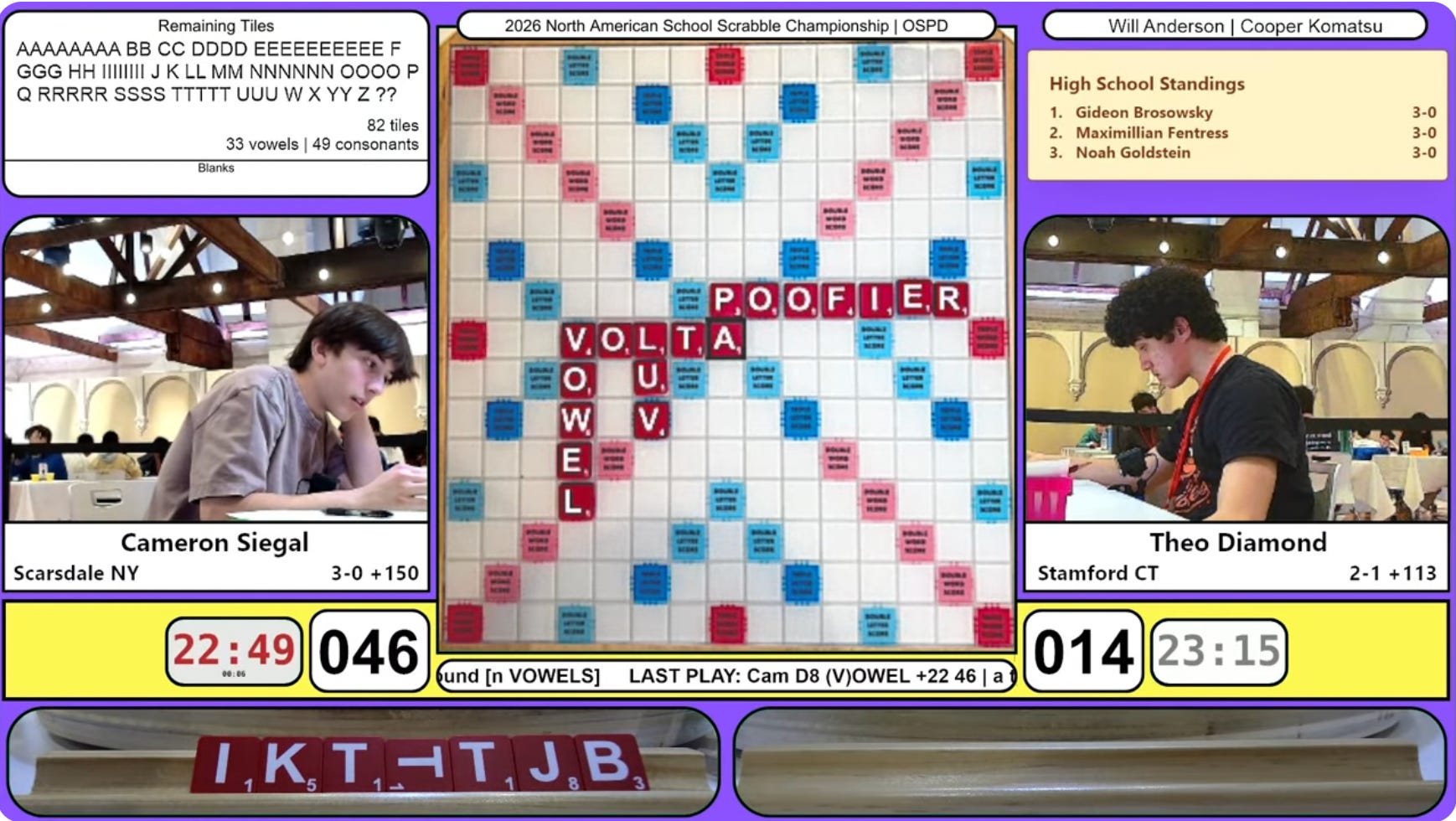
Will Anderson was commentating on the tournament livestream (the game starts at the 4:46:15 mark) with Cooper Komatsu, who in 2016 doubled as a School Scrabble champ and Scripps National Spelling Bee finalist. Will initially thought Theo had simply made a terrific play. Then doubt crept in.
“Is this one of those words, Cooper?" Will said.
“This is one of those words,” Cooper replied.
Cam put the play on “hold” while deciding whether to challenge. “Cameron is thinking something is up with this word,” Cooper said. Will mentioned my JAKER story. “We’ve got these little nuances that can really decide games,” he said. But Cam had a 62-point response, JIB atop the middle three letters of Theo’s bingo, so he let the play stand. “Clearly, Cam was dubious of this word but he wasn’t so sure of it to turn down this giant J play,” Will said. Also, Cam didn’t have anywhere else to score meaningfully, so he took the swap of high scores and moved on.
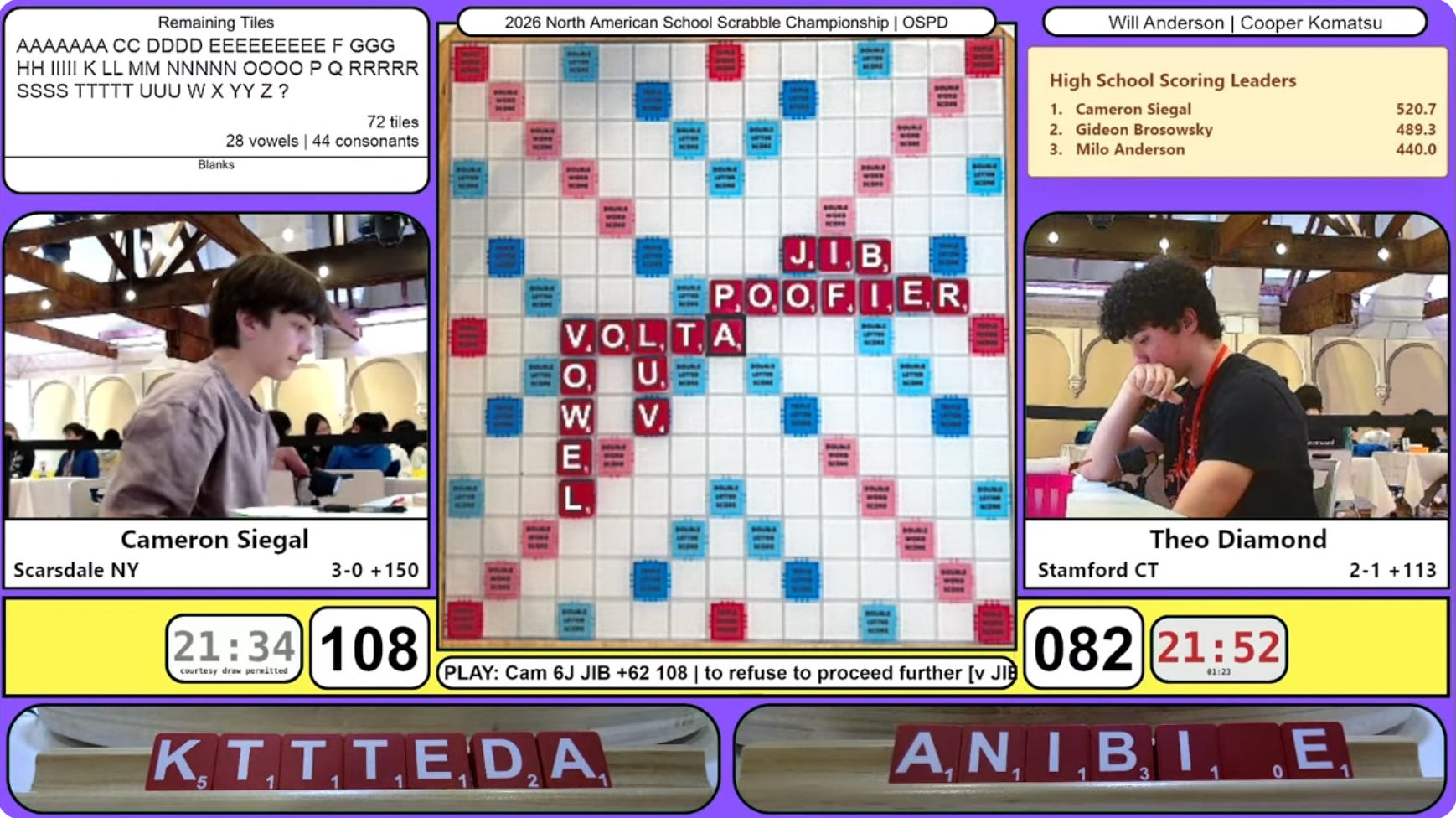
On the stream, Cooper attributed the confusion over POOFIER to “the intricacies of the School Scrabble dictionary.” But there’s more to the story.
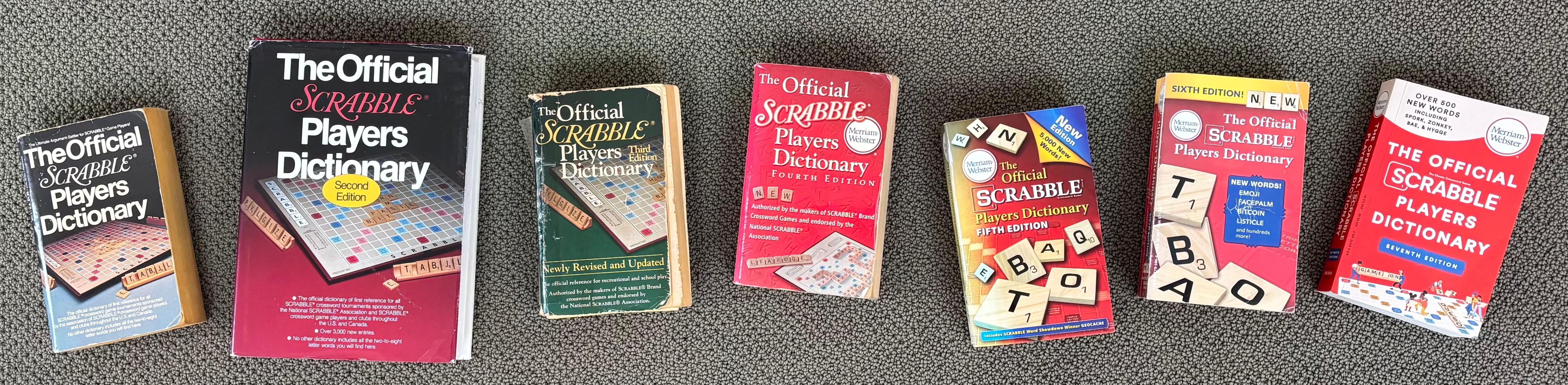
For reasons lost to time, POOF wasn’t in the inaugural edition of the OSPD, published by Merriam-Webster Inc. in 1978. The word joined Scrabble in 1990 in the second edition, OSPD2, where it was labeled a noun, not an interjection. For space reasons, entries in the Scrabble dictionary are truncated; if a word has more than one part of speech, the part with the most inflections gets the nod. OSPD2 defined POOF as “a male homosexual—an offensive term.” The plural was included, as were at least three related offensive nouns and the adjective POOFY, which also was labeled offensive. The comparative and superlative forms were not listed, meaning that the Merriam lexicographer who edited the OSPD may have determined that the inflections didn’t meet the dictionary’s criteria for entry.
A few years later, at Hasbro’s behest, every word labeled offensive was removed from the mass-market OSPD, around 200 in all. POOF was redefined as an interjection—“used to indicate an instantaneous occurrence.” But the offensive words lived on in a separate word list that was created for club and tournament Scrabble. In 2020, amid the nationwide protests against racism and police violence, the Scrabble organization NASPA Games removed a subset of offensive words it categorized as slurs, including the POOF inflections and derivatives. It was confusing—is GOY out? what about JESUIT?—but players tried to remember what had been removed and what hadn’t. (Another Scrabble sanctioning body, the Word Game Players’ Organization, or WGPO, retained the slurs.)
Then, in 2023, Merriam-Webster revised the OSPD and NASPA followed with its own update. The Scrabble group added nearly 5,000 words up to 15 letters long—but also readmitted some of the slurs it had previously deep-sixed. Why? NASPA decided that some of them, like REDNECK and SPAZ, weren’t linguistically slur-ry enough. (If a word was “at least sometimes offensive in at least one dictionary and personally applicable in at least one sense, but possibly not offensive and personally applicable in all senses,” a NASPA report said, it was allowed back in.) With others, it offered dubious lexicographic rationales for clemency. POOFY, the group explained, was resurrected because “although it was deleted for OSPD3”—in 1990, when the offensive words were struck from the Scrabble dictionary—”AH5 gives an alternate inoffensive sense (puffy).” AH5 is the fifth edition of the American Heritage Dictionary of the English Language, published in 2011. It wasn’t a source for the 2023 update.
The one-eighty on the slurs made little sense, except, as one Scrabble player told me, to the people now controlling the word list. Justifying a word previously declared a slur involved searching for evidence of non-offensive usage on Google or, as with POOFY, in dictionaries that weren’t used as sources for Scrabble. Or, in some cases, by deferring to old source dictionaries, which seems dicey when evaluating offensive language. Consider POMMY or POMMIE. It’s derogatory slang in Australia and New Zealand for a British person. NASPA deleted it as a slur in 2020 but added it back in 2023 on grounds that, while the word was labeled “offensive” in the second edition of the Canadian Oxford Dictionary, which was used as a Scrabble source in 2014, the fourth edition of Webster’s New World Dictionary “tags it only ‘sometimes derogatory.’ “ That book was published in 2004 and was used for Scrabble the following year. “If eliminating slurs is the goal,” the Scrabble player said, “it seems like you have to defer to modern sensibilities when newer and older sources differ.”
After I wrote about JAKER, a NASPA official took a little shot on Facebook at Merriam-Webster over licensing word lists to game developers—NASPA has landed two big clients for its list, the New York Times’s new Scrabble knockoff Crossplay and Scopely Inc.’s official Scrabble app. Even if Merriam licensed its list more aggressively, the official wrote, “not including words like VEGETABLE would make it hard to accept.”
That was a dig at the Scrabble Word Finder on Merriam-Webster’s website. Sometime after 2020, Merriam appears to have flagged words in the online lookup with labels like “offensive” and “disparaging.” And then deleted them. A couple dozen common words with secondary or tertiary offensive senses were caught in the net. VEGETABLE was one of them, because of the second subsense of its third sense (“informal + sometimes offensive : a person whose mental and physical functioning is severely impaired and especially one who requires supportive measures [such as mechanical ventilation] to survive.”) Others included UNCIVILIZED (“old-fashioned + often offensive : not having the kinds of social systems, technologies, etc. that are seen in most modern societies”); SNOWFLAKE (“informal + usually disparaging someone regarded or treated as unique or special” and “someone who is overly sensitive”; PRIMITIVE (“dated, sometimes offensive : a member of a people that is nonindustrial, often tribal, and often without a written language” and “disparaging + often offensive : an unsophisticated person”); DEFECTIVE (“dated, now offensive : having a physical or mental impairment); and POLITICIAN (“often disparaging : a person primarily interested in political office for selfish or other narrow usually short-sighted reasons”). Type the last one into the Scrabble Word Finder search bar and you’ll be told: “POLITICIAN is not a playable word.”
This is, of course, ridic (not yet good in Scrabble in North America), and dig-worthy. Merriam-Webster should have by now identified and corrected what looks like a programming error. But NASPA dragging Merriam for word-list flaws is a touch ironic, and biting the hand that feeds you. The group for years has received lists of new and longer words directly from Merriam. It's used those words not only for its official club and tournament lexicon, NWL, or NASPA Word List, but also for a list intended for school play, NSWL, or NASPA School Word List.
I checked the NASPA school list and guess what? The punch line VEGETABLE and others Merriam presumably unwittingly deleted from its lookup aren’t there. The Scrabble app ULU (an Inuit knife, but short here for Ultimate Lookup Utility) marks the words as having been on the NASPA school list in 2020 but removed in 2023.


What happened? Merriam-Webster likely gave NASPA the expurgated Scrabble Word Finder list but NASPA failed to crosscheck it against its 2020 school list. I discovered the discrepancies after asking ULU’s creator, Scrabble expert and retired Google software engineer Seth Lipkin, to run a side-by-side comparison. It’s an understandable oversight, but also a little bit lol. Bottom line: As I wrote last week, the state of Scrabble’s word lists is a collective shitshow.
After Cam’s game against Theo, the overhead board mic for the livestream caught the players checking their scores and reviewing their moves. Cam pointed at POOFIER.
“Is this good?” he said. “I thought they took out POOFY.” Cam’s buddy Noah walked by. “Did they take out POOFY?” Cam asked. “Or did they take out POOFED? Or is POOFY good? Or is it P-O-U-F-Y?” (Note: POOFED and POUFY have never been acceptable.)
“They added back POOFY,” Noah said.
“Good thing I didn’t challenge that!” Cam replied.

But then I stopped by the board and told everyone that while POOFY was indeed readded to the NASPA list, it was a slur and therefore not in the OSPD.
“POOFY is no good in School Scrabble? I knew it was something like that! I knew it, I knew it!” Cam exclaimed. “Why is it always me? Why is it always me, OSPD?”
I checked the online dictionary and was disappointed to see that "shitshow" is not playable.
It's a little astonishing to see that "politician" is considered a slur. That's just silly.
Thank you for another enjoyable newsletter!