

Separated by a Common Language (Part 1)
Scrabble in North America is a mess. Is it finally time to join the rest of the world?

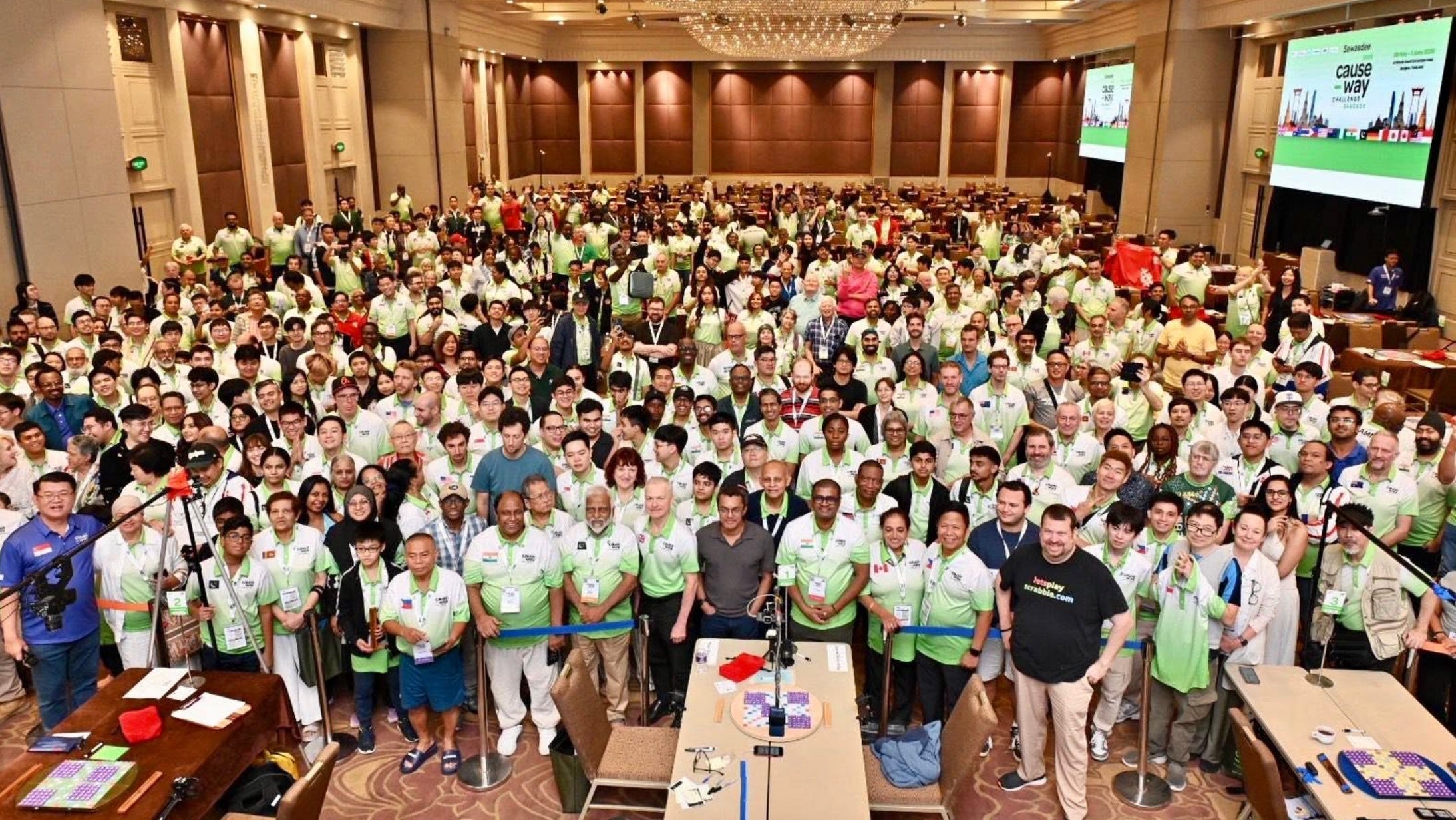
If that’s not the most Scrabble players in one photo, it’s gotta be close.
The picture is from a tournament in Bangkok, Thailand, a few weeks ago: 439 players from 30 countries; 36 games over four days; $70,000 in prizes. The field was among the strongest ever, with eight of the top 10 international players, including the GOAT, Nigel Richards of New Zealand, and No. 2-ranked David Eldar of Australia.1 After a slow start, Eldar won 13 of his last 14 games to clinch with a round to spare. Nigel lost an insane-for-him five straight games—the tile bag doesn’t know you’re a legend—and fell out of contention before rallying to wind up sixth.2
Bankrolled by a Singaporean player and media executive named Michael Tang, the 2026 Causeway Challenge was a Scrabble extravaganza. Tang booked all 270 rooms at a swanky hotel; fed breakfast and lunch to players and staff; and flew in a team of producers and commentators—including my 23-year-old daughter, Chloe, the highest-ranked woman player in North America—to livestream three games per round on two platforms.3 At the end of the four-day event, Tang announced that the next Causeway would be in 2028 at a resort in Kuala Lumpur, Malaysia. His audacious goal: 1,000 players from 50 countries. “It is my conviction that Scrabble deserves a spot as a celebrated mind sport in the mass media, and I hope to get it there,” Tang wrote on the tournament website.4
It’s my conviction, too, but the road to mass attention is potholed with disunity. For starters, Scrabble is owned by two different companies, Hasbro in North America and Mattel everywhere else. Neither invests much in tournament play—a single owner might be motivated to tap into the worldwide online audience for chess and other games.5 The situation in North America is a separate mess. There are two main governing bodies, NASPA and WGPO.6 Each has its own word list7, tournament schedule, championship, and rating system, and neither has much in the way of resources or ambition. For a game with just a couple thousand active players in the U.S. and Canada—if that—the schism, now more than a decade old, has seeded resentment, frustration, confusion, and anger among players. It’s stupid, selfish, and self-defeating. I’m not alone in wanting it to end.
But the lavish Causeway tournament in a bustling Asian capital got me thinking about an even longer-standing divide. To paraphrase George Bernard Shaw—or Oscar Wilde, or both or neither—Scrabble in North America and the rest of the world is separated by a common language. And the one that increasingly matters in the global subculture of the game isn’t the one that’s mainly used in the country where Scrabble was invented by architect Alfred Butts in New York City in the 1930s.
The word lists that adjudicate club and tournament Scrabble descend from the game’s owners’ relationships with local dictionary makers in the United States and United Kingdom The first official North American book, published in 1978, aggregated words from Merriam-Webster’s Collegiate and four other standard dictionaries. The first official U.K. one, published in 1980, used The Chambers Dictionary; fellow British publisher Collins took it over in 2003. Both sources have been updated multiple times since. People were arguing about the lists when I started playing tournament Scrabble in 1997 and published my book Word Freak in 2001, and they’re still arguing about them today.8
Thanks to the inclusion of English words from around the world and a nontrivial amount of obsolete stuff from long-dead Brits, the international list is substantially larger than the North American ones. The Collins lexicon contains 283,232 words two- through 15-letters long. NASPA’s list, known as NWL, has 196,639. The difference: a whopping 86,593 words. Very few players not named Nigel Richards memorize words longer than nine letters, though, and most stop at eight. That subset of Collins-only words—two through eight letters—is still huge, more than 31,000.
A couple of decades ago, North American players voted down a referendum to switch to the beefier international list. The main anti-Collins arguments are unchanged: 1) too many additional words, 2) too many of which are lexicographically unjustifiable in North America, and 3) too few Collins players in North America. To that you can add genuine affection for the more-restrained North American lexicon and recognition of the years of word-grinding top players have invested to master it. “I wouldn’t want to switch to Collins if it meant that I’d need to put in Herculean efforts to maintain my status at the top of Scrabble, when that feels unfair since I’ve already put in so much work to get there,” 2024 North American champion Mack Meller wrote on Facebook last year.9
The pro-Collins line is 1) more words produce a higher-scoring, more-exciting game, 2) the worthiness of individual words is irrelevant; every dictionary has its idiosyncracies, and 3) world unity is good for Scrabble, competitively and commercially. Bob Linn, who’s been playing in tournaments since 1986, told me that he opposed the international lexicon for years. “My view was, our game, we invented it, we set the rules, why should we use someone else’s dictionary—a very parochial dictionary,” he said. Then he qualified to play in a world championship, and that was that. “It’s so much more fun,” Linn said. “There’s so many new words and hooks that it creates a lot more activity.”
All of the top players have the neuronal makeup to learn the new words. Some hope to win NASPA’s North American championship (the WGPO title is seen as less prestigious) and then switch. For others, sticking with the local list is mostly about logistics. “I don’t have an ounce of care about that,” Orry Swift, who’s ranked ninth in North America, said of the additional Collins words. Swift is an accounting professor at Lamar University in Beaumont, Texas, and there aren’t many Collins players in Texas, and he likes playing in-state events a few times a year. Plus, he has two little kids. “I can’t fly to Thailand to play friggin’ Scrabble tournaments,” Swift told me.
For more than a decade, the official mantra has been coexistence, with separate divisions at tournaments here for the North American and international lists. But there’s been a slow drip of elite players, including some continental champs, switching lexical allegiances, and an influx of money encouraging non-champs to switch, too.10 Linn, a retired D.C.-area financial adviser, has donated a total of around $100,000 in each of the last two years to Collins events in cities including Montreal, New Orleans, and, next month, Albany, N.Y., where a large prize pool has attracted a bunch of grandmasters from overseas—Nigel Richards among them—who will stick around to play in the North American championships later in July.
Despite some gains, though, Collins is by no means taking over. Linn admitted that his efforts to get players to “see the light” hasn’t been very successful. “It’s a very, very small number that have switched,” he said. “Relative to the investment, it’s a poor return.”11 As of today, NASPA’s five-day, 31-game championship has more than six times as many registrants for NWL play (246) as for Collins (39).12
Still, the split has had effects both mundane and consequential. It’s not the Anchorman news teams rumbling with brass knuckles and hand grenades. But dinners and after-hours hangs tend to break down along dictionary lines; because the Collins and North American lists are so different, there’s little point in sharing and analyzing interesting plays and strategic quandaries. Some North American players won’t even look at a Collins board for fear of a Collins-only word glitching their brains like a computer virus.
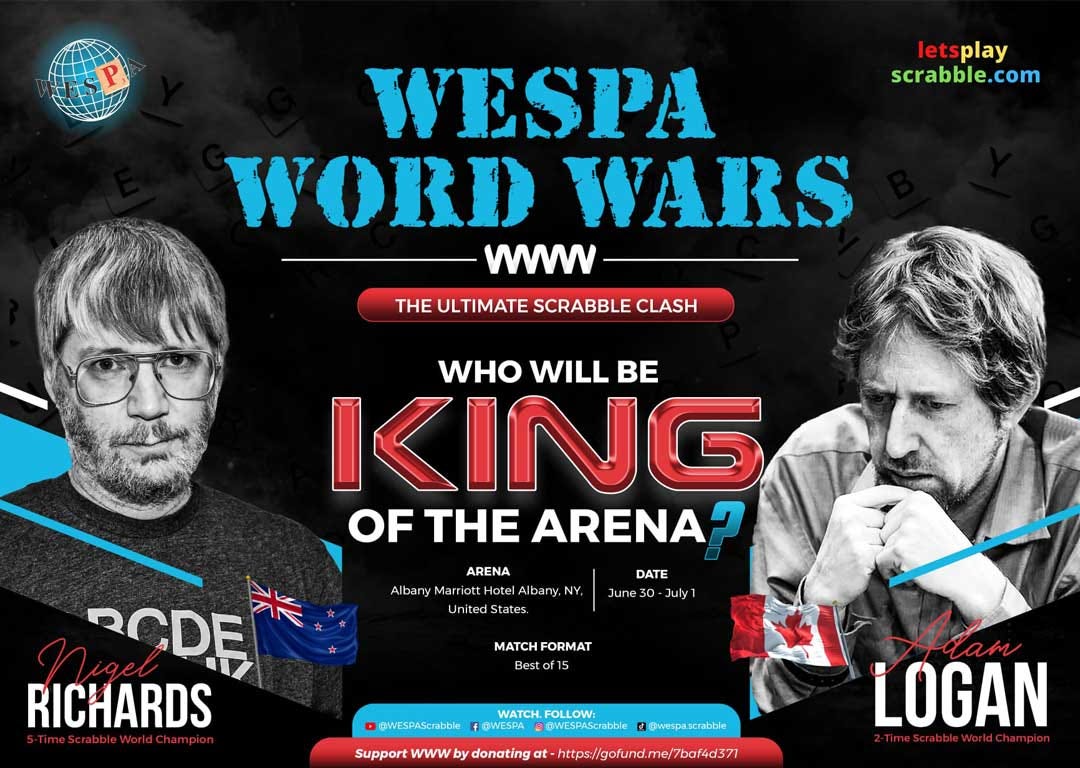
More important, the divide makes it harder to capitalize on growth online. An independent tournament operator in North America, Let’s Play Scrabble, has been creatively expanding the frequency and quality of livestreamed events, with a goal of promoting a full-fledged Scrabble broadcast tour. The World English Language Scrabble Players Association, WESPA, the game’s international governing body, is doing the same. Before the Albany tournament next month, the two groups are jointly staging a 15-game match between Nigel Richards, who’s won the world championship five times, and Adam Logan of Canada, who knocked off Nigel last year in Accra, Ghana, for his second crown.
But livestreams of North American events often toggle between the two lexicons to satisfy viewers from both groups, cannibalizing an already tiny audience when players click away because the other dictionary is on. Similarly, on his popular YouTube channel, 2017 North American champion Will Anderson (who mostly plays Collins now but competes occasionally under the domestic list) has to label Collins-only words with a hashtag13 and tailor analysis to the given word list. Good luck explaining the dichotomy to a potential sponsor.
I used to think that a Camp David-style summit could produce lexical détente: the Collins forces would agree to purge the thousands of obsolete and archaic words, North America would agree to adopt the still-much-fatter list, global harmony would ensue. It would be a big ask for both sides: North Americans would still face the prospect of memorizing an absolute shit-ton of new words, while Collins players would have to unlearn thousands of words. That can be much harder than learning words, which is why Scrabble lexicons have contracted only in rare circumstances, to remove errors or slurs.
But while the commercial incentive to unite should override the lexical differences, the balance of power in the game has shifted. Chris Lipe, an American player who was chair of WESPA from 2019-25 and is currently its board secretary, told me that when he started working with the group, more than a decade ago, there was an appetite to compromise to get North America aboard. Today, not so much. “The overall influence of North America in global Scrabble has waned to the point where I’m not sure it’s feasible,” Lipe said. “I could probably sell the larger community on some small-scale tinkering to take out some of the really bizarre or nonsensical stuff, but deleting hundreds of obsolete words is probably not on the table.”
North America is adequately represented in the international game, with 10 of the top 30 players in the WESPA world rankings. Overall, though, Nigeria has as many WESPA- rated players as the U.S. and Canada combined. Indeed, countries like Nigeria, Ghana, India, Pakistan, Malaysia, and Singapore all boast active playing scenes that include armies of schoolchildren. The revelation at the Causeway Challenge was 15-year-old prodigy Madhav Gopal Kamath of India, whose eighth-place finish catapulted him into the Top 10 in the world. “People have realized that the future of Scrabble is the thousand Pakistani kids playing Collins in their youth nationals,” Lipe said, “and not a few dozen American kids playing OSPD,” the lexicon used in the North American school championship.
This side of the Atlantic—and Pacific—is the lexical outlier now. My daughter told me that players in Bangkok asked her what was up with our word list. “It’s seen as this fringe thing,” Chloe said. “It’s like the weird cousin.” Not that WESPA officials don’t want North America to end what to international players looks like Scrabble isolationism. But, Lipe said, “it’s no longer a strategic goal the way it used to be. It’s much more to North American players’ benefit to do this than the rest of the world, who will keep raising the profile and growing the player base of the game—primarily in the global South—either way.”
Do North American players think it would be to their benefit? Most would still say no. The narrow desires of players here are adequately met: local clubs and a slate of regular tournaments. And we’ve already got plenty of words. I personally wouldn’t be down for a wholesale, overnight move to Collins: I’m not a top expert who’s already mastered the North American lexicon and is ready for a new challenge; most of my friends compete under the North American lists; and, as strategically interesting as Collins may be, I have zero desire to face the pressure of immediately learning thousands of words in order to compete against players who’ve already done that work.
But here comes the “but.” But I hate that American exceptionalism and organizational dysfunction has contributed to this divide for decades. And I do believe that Scrabble would be better off with a worldwide lexicon—that unification would make the game more sellable to Scrabble’s owners, potential sponsors, and people who come across the game online and want to try playing in real life. “It is the only viable path toward the global growth and advancement of Scrabble,” the current WESPA chair, Lukeman Omo-Owolabi of Nigeria, wrote earlier this month in a Facebook discussion about the dueling lexicons.
Plus, a single dictionary would foster more of the camaraderie and shared experience that make any subculture—and definitely this one—attractive to people who discover they belong there. “At the end of the day there’s this segregation of extremely like-minded people. It’s so ridiculous,” Josh Sokol of Montreal, who switched to Collins after winning the 2023 NASPA championship, told me. The internet has already shrunk the Scrabble world; in Bangkok, school-age players recognized Chloe from some of Will Anderson’s videos and asked her to sign autographs and racks.14 Why not bridge the main remaining divide?
And while I can and will beef about the crazy shit in Collins, the seeming strangeness of some words is, in the end, a feature not a bug of competitive Scrabble, regardless of lexicon. “English is weird,” a top player once told me. “Words come and go.” The addition of what for most tournament players would be a few thousand words—the basic Collins words that an intermediate- to expert-level player would need to learn to maintain their level—would absolutely alter the strategy and feel of the game. But it wouldn’t be the first time (oh the caterwauling when QI and ZA were added 20 years ago) and it wouldn’t change some fundamental realities: Scrabble is language-inclusive. Over the board, meanings don’t matter. One of the game’s joys is liberating troves of obscure, uncommon, odd-looking English words from the purgatory of the dictionaries that house them.
In Part 2, I’ll explore the history of the trans-Atlantic word gap—and propose a plan to do something about it.
Nigel may not have won this tournament but he still Nigel-ed. In Round 3, against Indian grandmaster Akshay Bhandarkar, Nigel held a rack of DEHIPR and a blank and played the nine-letter ERIOPHYID through the IO already on the board, making the blank a Y, which is sick. Here’s a link to the game.


You can watch the full tournament or round-by-round coverage on Table 1, Table 2, and Table 3. Chloe was on the mic on Table 2 alongside 2023 North American champ Josh Sokol. I particularly recommend Game 31 between Eldar and Josh Castellano of the U.S. at the start of final day coverage (stick around for Chloe’s hilarious postgame interview with Eldar); Game 32 between Eldar and 15-year-old Indian phenom Madhav Gopal Kamath on Table 1; and the decisive Game 35 between Eldar and former world champ Dave Wiegand of the U.S. on Table 1. In addition to the livestream, Tang deployed a team of young Thai players to record every move of every game on the top nine tables in the premier division, which were uploaded to the Scrabble playing and analysis site Woogles, an analytics trove of more than 300 games in all.
Tang’s media operation in Bangkok also featured a series of interviews dubbed Humans of Causeway that captured the enthusiasm and hopes for the game. Watch this one with Bright Idahosa, the earnest head of the Scrabble federation in Nigeria, which boasts many of the world’s top players—and where the game is supported by the country’s National Sports Commission and gets regular media coverage. “What I see here is the future that Scrabble can be,” Idahosa said. “We need to get out from our bedrooms, get out from our tables, and go out there to bring in money to sponsor it. What’s stopping us from having $100,000 first prize for Scrabble? If we keep doing this and sustaining it, we’re gonna get the right eyes to look at us, and money will come into the game.” Also check out this sweet chat with 12-year-old Tehash Kodikara of Sri Lanka, who said that Scrabble relaxes him, which I wish I could also say. “When I just play it just rips me away from my other problems,” he said. “It’s like another world for me.” Asked if there was anything else he wanted to add, Tehash looked right into the camera: “Scrabble is better than chess!” Love this kid.
Hasbro for a quarter century licensed an independent organization, the National Scrabble Association, with a full staff and an annual budget as high as around $800,000. The company stopped supporting club and tournament Scrabble in 2013—which I wrote about at the time in the New York Times—and it terminated a licensing agreement with an independent successor organization, now known as NASPA Games, in 2021. But Hasbro has continued to provide the bulk of the funding, plus swag and prizes, for the annual North American School Scrabble Championship. WGPO also has helped fund the event. Full disclosure: I’ve helped organize that event since 2022.
NASPA used to be the North American Scrabble Players Association, but formally changed its name to NASPA Games after Hasbro severed its license. WGPO is the Word Game Players’ Organization, pronounced wig-po. Both organizations avoid using the word “Scrabble” because they don’t have permission from Hasbro to do so to market the game.
As I wrote in Slate in 2023, NASPA has deviated in recent years from the standard practice that words deemed acceptable in competitive Scrabble need to appear directly in a source dictionary or be okayed by the professional lexicographers at Merriam-Webster. WGPO refused to add many of NASPA’s most recent additions—lots of sus inflections like FECESES and NEWSES—on grounds that, well, they’re not valid words. But WGPO’s membership also short-sightedly rejected NASPA’s decision in 2020 to remove around 200 words categorized as slurs. So when you play tournaments sanctioned by one group or the other, you have to try to remember which words are in one list and which are not, a needless, annoying, and mistake-inducing process.
The dictionary divide occasionally bubbles up into mainstream media. Here’s a 2015 piece by Charles Bethea in The New Yorker.
Now in his mid-20s, Meller achieved at expert rating at age 10 and soared to the top ranks by his mid-teens. He’s widely regarded as knowing more words—including more nine-letter and longer words—than any NWL player. A Columbia University grad who worked for a short time on Wall Street, Meller is crafting a career out of games, giving Scrabble lessons, constructing crosswords and other puzzles, and generating smart and entertaining content on his YouTube channel. His 3,600-word post, titled “Why I’m sticking with NWL over Collins,” generated a respectful conversation, both pro- and anti-Collins. More than one player argued (and I concur) that Meller would have no trouble quickly securing his status in the international lexicon. “You mention how daunting 30k new words would be to learn, and I agree. I’m struggling hard,” Josh Sokol, who switched to Collins after winning the NASPA title in 2023, wrote. “You on the other hand are far better than me and pretty much anyone at learning and retaining new words. And despite me not knowing anywhere near enough to be comfortable, I am competitive with the top players. This idea of you getting destroyed by [them] is completely irrational, I’m afraid.” If he wanted to, Mack would crush it in Collins, and it wouldn’t take him long to do so. Here’s a good profile of Meller in Columbia’s alumni magazine in 2017 and here’s a piece I wrote in Slate breaking down a game between Meller and Anderson at the 2017 North American championship.
There’s even another organization, Collins Coalition, or CoCo, that runs tournaments in North America using only the international lexicon.
So why is Linn investing in it? Like Michael Tang and another American player, Jon Shreve, whose family foundation donates $100,000 annually to support WGPO tournaments, Linn is willing to pump his own money into the game he loves. “You can’t take it with you when you die,” said Linn, who’s 82, “so you might as well do something with it when you’re here. You might as well do something you believe in.”
NASPA’s championship (which Chloe and I will attend) is in Cedar Rapids, Iowa. WGPO’s (which we can’t) is in Williamsburg, Va. No shade to either city, but Bangkok they’re not. A friend stopped playing big Scrabble events in North America in favor of Pokémon tournaments that have taken him to Copenhagen, Lima, and other comparatively exotic destinations.
Why the hashtag? Because it was the symbol for lb., the abbreviation for the Latin libra pondo, or “pound weight” or just “pounds.” (How did it become the symbol? Read the wiki.) Since the British currency was also the pound, someone in Scrabble decided that # made sense as the symbol to denote a British-only word. Correspondingly, a word that only appeared on the North American list was affixed with a $.
I’ve gone from “author of Word Freak” to “Chloe’s dad.”
Love the footnotes. Number 14 is the best :)
yeah, it'll be work to learn the extra collins words, but i'm ready for north america to make the switch. thanks for covering this in such detail!